
Duarte Previous Residents Coverage
The local trail has distinct era strengths. A record gap in one column can often be bridged by another, but no source covers every household or every year.
| Source | Years It Covers | Where Held | What It Shows |
|---|---|---|---|
| Recorder deeds and index | 1851 to present for review; maintained since 1850 or 1851 | RR/CC Norwalk | Ownership, encumbrance chain, legal description |
| City and telephone directories | 1908-1971, incomplete | Monrovia Heritage Room | Adult occupants, occupations, address, phone context |
| Combined and standalone Duarte directories | 1924, 1925, 1928; 1937, 1939, 1944, 1948 verified | Library catalog or licensed database | Searchable household and business entries, image access varies |
| Federal census | 1850-1950 released schedules | NARA, FamilySearch, libraries | Households, relationships, ages, occupations, location |
| Newspapers | 1886-1992 named local runs, with gaps | Heritage Room and digitized runs | Moves, obituaries, permits, social news |
| City permits | Dates vary; municipal files and microfiche | Duarte City Clerk or local library | Alterations, applicants, contractors, inspections |
| Bradbury Land Papers | 1855-1933 | Huntington Library | Rancho-era deeds, mortgages, leases, water rights |
This is why previous residents cannot be reconstructed from one “past occupants” list. The deed chain supplies owners, the directories supply named adults, and the household sources supply family structure.
Duarte's Current Parcel and AIN
A house history starts with the parcel, not an old street number. Enter the current address or AIN in the Los Angeles County Assessor Portal. Save the situs wording, mapped parcel, assessment effective date, and any legal or tract context. The physical situs is the place being assessed; a mailing address may point to an owner elsewhere. Carry the AIN and legal description through every later search. The current address chain can be organized with the Duarte street directory before the backward search begins.
The recorder chain concerns legal parties to a conveyance. A city directory concerns printed adult occupants. A permit concerns an applicant, owner, contractor, work date, or inspection. A census concerns household members at the time an enumerator visited. These records can describe the same address without describing the same people.
- AIN
- Assessor Identification Number, the county parcel key.
- Legal description
- Tract, lot, block, or other land language used to keep the parcel identifiable when street numbers change.
- Occupant
- A person listed at an address in a source, not necessarily an owner or current resident.
Previous residents are easiest to trace when the worksheet preserves the source, year, record role, street wording, and uncertainty for every name.
Duarte Sellers as Earlier Buyers
Los Angeles County's recorder index is organized by grantor, grantee, and year, not by street address. A grantor conveys an interest; a grantee receives it. The backward deed method treats each seller as a possible earlier buyer and follows the legal description through time.
- Locate the current parcel in the Assessor Portal and write down AIN, situs, and legal description.
- Find a current deed or likely recorded instrument through the owner's papers, known document number, or Norwalk index.
- Copy the grantor, grantee, recording year, document number, book and page, and legal description.
- Search the grantor as an earlier grantee in the likely prior years.
- Repeat until the index, legal description, or available volume reaches a limit, then switch to maps, directories, or archives.
The full instrument may show vesting names, legal description, execution and recording data, signatures, notarial acknowledgment, and return information. Copies can be ordered online, by mail, fax, or at the counter after the document is identified. The Los Angeles County recorder FAQ confirms the grantor, grantee, and year arrangement and the lack of an address-key Internet search.
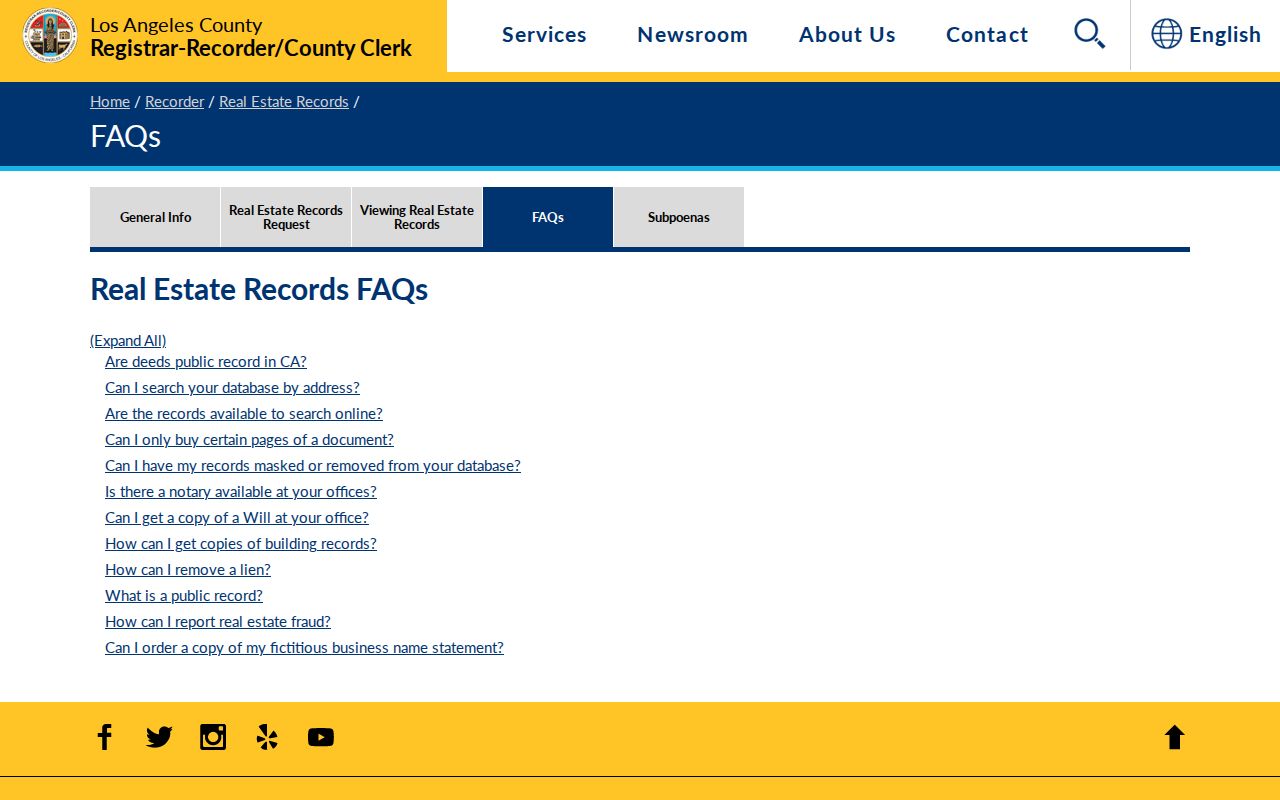
The recorder FAQ is a useful checkpoint before spending time on a street-number search the county index cannot perform.
Duarte Recorder's Era Boundary
The Norwalk review floor changes by era. The research describes 1851 through 1957 on the lower level and 1958 through the present on the second floor. The county says real-estate records are maintained from 1850 or 1851. This analog arrangement matters when a prior owner seems to vanish at the edge of a modern online copy workflow.
Remote ordering is a known-document service. It is not an exploratory search by address or telephone. Plan the counter visit around the names and years you already developed from the current parcel and later deeds. Ask about the document number, book and page, current copy price, and the complete instrument before relying on an image or an index note.
A chain can also include deeds of trust, liens, releases, notices, and plats. Read the instrument type before treating a party as a past owner. A name on an encumbrance document may not be the same as the person who held title.
Duarte Owners and Historic Occupants
Deeds show recorded parties. City directories show listed adults. A directory may mark a home, residence, rooming status, occupation, spouse, or widow notation, but its conventions vary. A person can occupy a house without holding title, and an owner can receive mail elsewhere. Keep owner and occupant columns separate from the start.
The Heritage Room's incomplete 1908 through 1971 city and telephone run is the most useful local bridge. Combined Monrovia-Arcadia-Duarte volumes are verified for 1924, 1925, and 1928. Standalone Duarte listings are verified for 1937, 1939, 1944, and 1948. Check the catalog under Monrovia, Arcadia, and Duarte because the community name may not appear on the cover.
The complete collection story belongs on the Duarte city directory page. A previous-residents search uses those volumes as time-stamped occupancy evidence, then tests the names against census, newspaper, permit, probate, or vital records.
Note: “Not found” in an incomplete directory means the name was not found in that source, not that the address was vacant.
Duarte House-Research Guide
The Monrovia Public Library house-research guide is a practical local method. It points researchers to street-address and picture indexes, directories, historical permit microfiche, house-tour folders, indexed histories, and newspaper microfilm. For a Duarte address, ask whether the 1957 Monrovia-Duarte Community Book or a combined directory includes the number, then request municipal Duarte permits separately.
Historical permit microfiche can date an alteration even when a directory does not explain the change. A city request may return applications, issued permits, plan-card chronology, inspection signoffs, and certificates of occupancy, subject to plan-security or copyright limits. A 2025 cultural-resource study documents consultants recovering subject-property permits through the Duarte City Clerk, which shows that the request route can produce address history.
The local house-research guide should be read as a source map, not as proof that every listed item exists for every Duarte address.
Duarte Tracts Bridge Address Gaps
No authoritative Duarte-wide street-renumbering chronology was verified. That gap is a reason to use legal continuity. Save tract, lot, block, cross streets, AIN, and the exact old street wording. A modern house number may not match a rancho or subdivision reference, but a legal description can connect them.
Duarte developed from the 1841 Rancho Azusa de Duarte grant and the later division of remaining rancho land into 40-acre parcels by 1872. The Bradbury Land Papers preserve 1855 through 1933 title certificates, deeds, land-sale contracts, mortgages, leases, and water rights. These materials can place a landholder or parcel before the modern address grid.
When a number seems to disappear, search both the old and current street wording, then compare the map, legal description, and directory street section. Do not invent a readdressing date or claim that a particular road changed without an authoritative city or county record.
Duarte Directories, Census, and News
A directory year gives an address snapshot. The federal census can supply household relationships, ages, birthplace, and occupation. A newspaper can explain a move, death, sale, permit, marriage, or civic role. The previous residents trail becomes persuasive when the same address, person, or family appears in more than one source.
- Copy the closest directory entry and its street-section context.
- Compare the nearest released census, noting who was counted in the household.
- Search the local newspaper run for the transition window and address wording.
- Check permits for alteration dates and probate or vital records for death or family events.
- Return to the deed chain to separate the household's presence from the owner's title.
For example, a 1950 census household, 1957 community-book entry, 1960s directory address, permit microfiche item, and later obituary can form a coherent family-history trail without pretending that any one source is complete.
Duarte Obituaries and Probate
When a former occupant disappears from the directories, the next source may be a local obituary or probate case. The Heritage Room newspaper runs include local papers from 1886 through 1992, with gaps. An obituary can connect a name, spouse, relatives, address, and life event. A public probate petition may name a decedent, petitioner, heirs, and estate property. Protected filings remain unavailable.
Use a newspaper or funeral-home notice as a lead. Confirm the event with California vital records, a court file, or another custodian. CDPH uses authorized and informational copies, and an informational copy cannot establish identity. Confidential marriage and sealed adoption or original-birth material follow stricter rules.
Probate property can lead back to the recorder's legal description. That loop is useful for past residents because it joins people, land, and time without turning an obituary into proof of every household member.
Duarte Rancho-Era Land Papers
The oldest previous residents may not be found through a city directory at all. Rancho-era land papers can identify landholders, title transfers, water rights, and leases before modern street numbers. The Huntington Library's Bradbury Land Papers finding aid covers 54 items from 1855 through 1933 and is tied directly to Rancho Azusa de Duarte and Monrovia land development.
Use the rancho name, landholder, tract, and water-right terms alongside modern parcel clues. A historical title record can explain why a later street sits on a particular subdivision or orchard parcel. It can also provide a person name to test in newspapers, census schedules, and combined directories.
The Bradbury Land Papers finding aid is an archive route, not a modern resident search. Its value is the bridge from land history to later address history.
Duarte Past Households Need a Stop Point
Previous residents are a lawful house-history and genealogy question when the research stays tied to public records and respects living people's safety. The record trail can show that an owner conveyed land, that an adult was listed in a directory, or that a household appeared in a census. It cannot authorize a search for every private person connected to an address.
Lawful personal use. Use past-resident records for family history, property history, heir research, or reconnecting when contact is welcome. Do not use an address trail to stalk, harass, threaten, intimidate, or harm anyone.
Safe at Home participants receive a substitute mailing address, and voter, DMV, utility, delivery, sealed court, and protected vital information may not be available. If a public record appears wrong, contact the recorder, assessor, court, city clerk, library, or other custodian that holds it. A private search result cannot correct an official file.
Note: A complete house history is a chain of dated evidence with stated gaps, not a claim that every previous resident can be named.