
Duarte's City Directory Collections
A city directory is a snapshot, not a complete census. Duarte often appears as a section within a Monrovia or Monrovia-Arcadia volume. The best search starts with all three community names, then checks the surname and street sections inside the volume. Printed city directories can list adults, spouses, occupations, addresses, businesses, and phone details. They can also omit children, boarders, recent movers, and people who did not answer a canvass.
The local shelf is valuable because Duarte was incorporated in 1957 and its record geography changed over time. A combined title can preserve a household before the city name became common on the cover. A reverse section can put the same household into a street context. A directory entry is strongest when its year, publisher, page, section, and exact spelling are saved beside the later confirmation record.
| Collection | Years | Where Held | Access |
|---|---|---|---|
| City and telephone directories | 1908-1971, incomplete | Monrovia Heritage Room | Library use with ID; appointment help |
| Monrovia-Arcadia-Duarte directories | 1924, 1925, 1928 verified | FamilySearch catalog or library-licensed databases | Card or account may be needed for images |
| Standalone Duarte listings | 1937, 1939, 1944, 1948 verified | Catalog listings and library resources | Check exact image access by year |
| 1957 Monrovia-Duarte Community Book | 1957 | Heritage Room and online index | Named residents and organizations |
| Historical volumes | 1938, 1943, 1964 | Heritage Room | Indexed local-history use |
The research shelf is broad but incomplete, so a missing year must not be read as a missing household. Check the exact volume and whether its address section is present.
Duarte Heritage Room Directory Run
Monrovia Public Library's Heritage Room reports an incomplete city and telephone directory run from 1908 through 1971. Most local-history material is used inside the library, and identification may be required. Adult Services asks researchers to arrange microfilm help at (626) 256-8259. A local-history appointment can be arranged at (626) 256-8274. The room is the practical center for a Duarte city directory search because it holds directories, newspapers, permit microfiche, community books, and indexed histories together.
The room's 1908 to 1971 run is incomplete. Note the exact volume and check whether its address section is present before assuming that a street scan is available.
Verified Duarte Volumes by Year
Catalog wording is part of the search. Combined titles verified in the research include Monrovia-Arcadia-Duarte directories for 1924, 1925, and 1928. Standalone Duarte listings are verified for 1937, 1939, 1944, and 1948. These years form a useful bridge between the early combined community setting and later Duarte identity, but they do not create a continuous series.
Search under Duarte, Monrovia, and Arcadia, plus common spelling variants. A title may use a dash between community names or place Duarte in a section rather than in the main title. FamilySearch's California catalog and a library-licensed genealogy database may show a record or scan, while exact image access can require a card or account. The Heritage Room remains the place to ask about gaps, local holdings, and printed reverse sections.
- 1908: the Heritage Room's reported incomplete city and telephone directory run begins.
- 1924, 1925, 1928: combined Monrovia-Arcadia-Duarte catalog years are verified.
- 1937, 1939, 1944, 1948: standalone Duarte listings are verified in catalog material.
- 1957: the Monrovia-Duarte Community Book captures residents, organizations, and a first-Council photograph reference.
- 1971: the reported local run reaches its latest stated year, with gaps still possible.
Record a negative search with the catalog terms used, the year checked, and the section that was unavailable. That small habit prevents a catalog gap from becoming a false claim that the person or address did not exist.
Note: Combined-community cataloging is a Duarte quirk, so search the neighboring city names before giving up on a directory year.
How a Duarte Entry Reads
A typical city directory entry begins in the alphabetical section. It may give surname, given name or initial, spouse in parentheses, occupation, employer, residence street address, and a widow or widower notation. A business section can add a firm, category, telephone, address, and proprietor. Some volumes include a street or criss-cross section that reverses the search from surname to house number.
| Name | Surname and given name or initial; a spouse may appear in parentheses. |
|---|---|
| Occupation | Job title and sometimes employer, useful for separating same-name entries. |
| Address | House number and street wording as printed in that year. |
| Owner or renter mark | Use only the symbol explained by that publisher's key. |
| Widow notation | A mark such as “wid” can narrow a death or household-change window. |
- Criss-cross directory
- A reverse directory arranged by street and number instead of surname.
- Householder index
- An alphabetical or address aid that points to the main adult listed for a household.
- Abbreviation key
- The publisher's guide to short forms such as home, resides, widow, and occupation marks.
Photograph or transcribe the abbreviation key before reading a full run. “r” and “h” can carry different meanings across publishers. Treat an entry as evidence of a printed snapshot, then compare it with another year or record type.
Duarte Street Sections in Reverse
The reverse half of a city directory is the historical counterpart to a modern address map. Find the street, scan house numbers in sequence, and copy each adult occupant or business exactly as printed. Then return to the alphabetical pages and compare occupation, spouse, and address. Neighboring numbers can expose a same-name mistake or show that a family moved within Duarte.
Coverage is volume dependent. Not every year has a criss-cross section, and not every street is complete. A directory gap may reflect publication, canvass, or preservation limits. The city directory becomes stronger when the street entry is paired with a census household, a local newspaper notice, a permit file, or a deed chain. Modern address-keyed work belongs in the Duarte street directory workflow, which uses the assessor and recorder rather than rebuilding the historical shelf.
Duarte Directories and Census Years
Federal census schedules released through 1950 under the 72-year rule can fill the gaps between directory snapshots. A directory may show an adult's address and occupation. A census can add relationship, age, birthplace, and other household members. The two records answer different questions, so a mismatch deserves explanation rather than quick rejection.
- Find the closest directory year and copy the name, spouse, address, occupation, and any mark.
- Check the street section for the same number and nearby entries.
- Compare the entry with the nearest released census, noting age, relationships, birthplace, and household size.
- Move to the next directory year and mark moves, a changed spouse note, or a widow notation.
- Use newspaper, probate, deed, permit, or vital records to test the reason for a change.
For a person who disappears, possible explanations include a move, death, nonresponse, a changed surname, or a missing volume. An absence is a research result, not proof of vacancy.
Duarte Newspapers Fill the Gaps
The Heritage Room's local newspaper run is unusually broad. Named holdings include the Monrovia Planet from December 1886 through June 1888; the Monrovia Messenger in several runs from 1888 through 1915; Monrovia News Weekly from 1907 through 1912; Monrovia Daily News from 1910 through 1929; Monrovia Daily News Post in 1929; and Monrovia News Post from July 1929 through July 1992. Some dates are missing, so check the actual reel or digital index.
Obituaries can connect a name to a family, address, and life event. Sale notices and social columns can mark a move. Permit stories and local civic news can place a household near a project or organization. The Duarte Library keeps current regional newspapers and offers research help, while the Heritage Room handles the older microfilm trail. A newspaper lead still needs confirmation through a vital, probate, deed, or court record.
Duarte's 1957 Community Book
The Monrovia-Duarte Community Book gives the 1957 directory search a local civic anchor. Its index names residents and organizations and points to an early Duarte City Council photograph. The image reference is dated August 22, 1957 and names Judge John A. H. Sturgeon, Jeanne Abouchar, Vera Hacker, Mayor Walter C. Hendrix, John E. Lindfors, and Robert K. Swain. This is a concrete bridge between directory-style people research and the municipal transition of incorporation.
The Duarte Historical Society collection description adds the local museum and preservation context behind those names and community records.
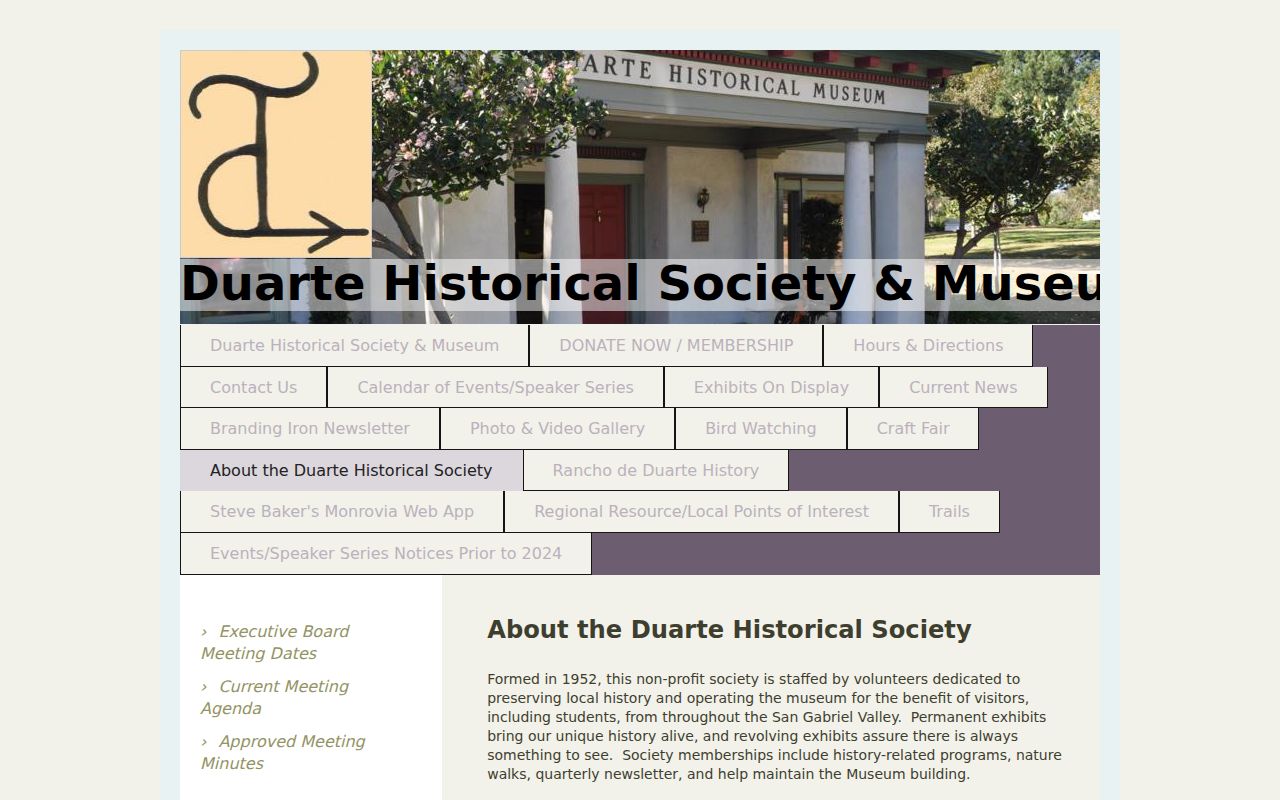
The Historical Society view complements the Heritage Room by preserving local photographs, publications, and volunteer knowledge that may not appear in a directory index.
Use the book as a community snapshot, not as a full roll. Pair a name with the surrounding directory entry, local newspaper, city minutes, or a later census. The Heritage Room's indexed local-history volumes can also connect a household to organizations and places that do not appear in the assessor parcel record.
A named organization can help distinguish two people with the same surname, but public community information should not be treated as permission to obtain private membership data.
Duarte Permits and the House Guide
The Monrovia Public Library house-research guide joins address indexes, picture indexes, directories, historical permit microfiche, house-tour folders, local-history books, and newspaper microfilm. For Duarte, the guide is a method source, while current municipal permit files come through the Duarte City Clerk. Ask whether a specific address appears in the 1957 book or a combined directory, then request Duarte permits separately.
Historical permit microfiche can date alterations and may be scanned or emailed from the library when the item is held there. The city request can add application, inspection, contractor, and certificate details. Neither source is a continuous list of residents. They are time markers that make a directory address easier to interpret.
The house guide is available as a Monrovia and Duarte house-research PDF. Its local emphasis is why a Duarte city directory search should not stop at a national genealogy catalog.
Duarte Rancho Names in Land Papers
Modern street numbers do not reach all the way back to Duarte's first land records. The 1841 Rancho Azusa de Duarte grant to Andrés Duarte and the division of much remaining rancho land into 40-acre parcels by 1872 create an older naming system. The Huntington Library's Bradbury Land Papers preserve 54 items dated 1855 through 1933, including title certificates, deeds, land-sale contracts, mortgages, leases, and water-right documents tied to Rancho Azusa de Duarte and Monrovia.
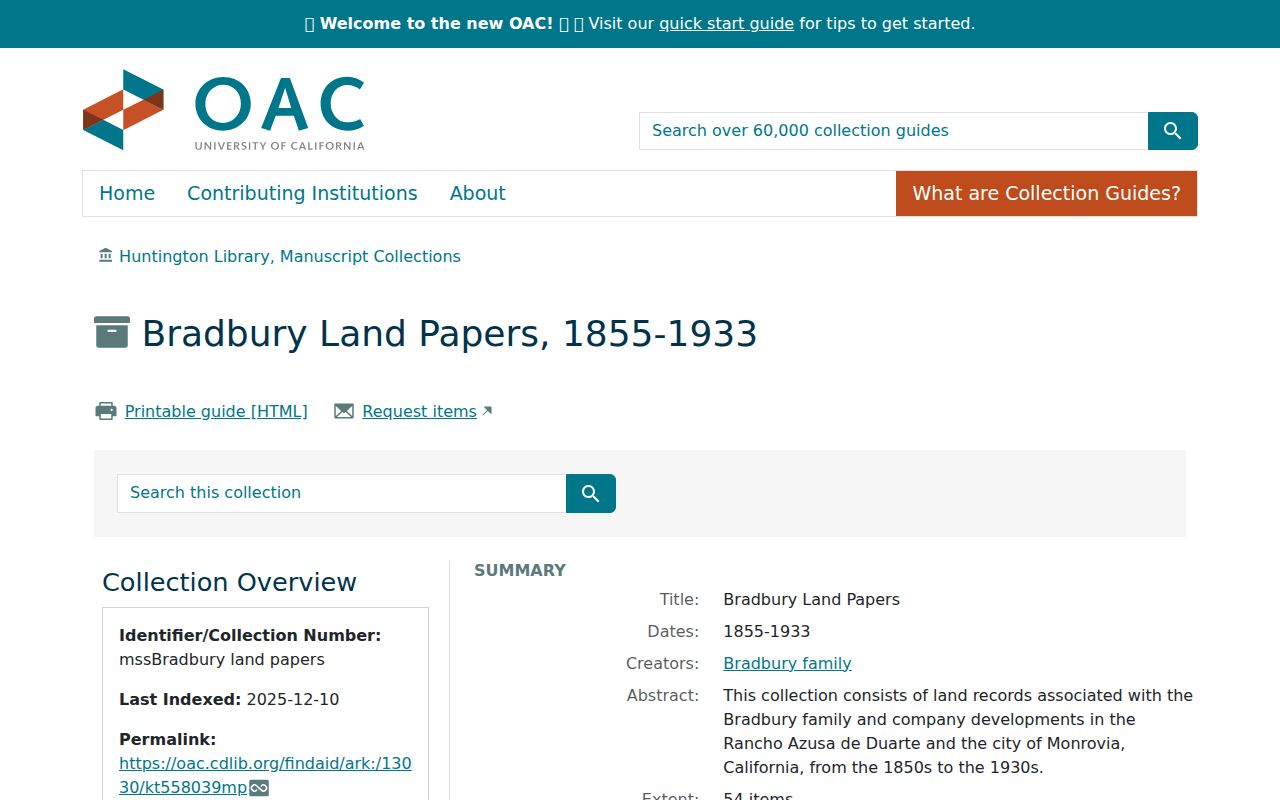
The Bradbury finding aid shows the kind of land paper that can bridge a ranch, tract, or water-right name to a later address.
For family history, a land paper can supply a person or parcel clue that a city directory could never show. Carry the legal description forward into the county deed chain, then use later city directories to identify the adults who occupied the developed address.
Note: The local story is a recordkeeping bridge from rancho descriptions to combined community directories, not a claim that every early landholder later lived at the same address.
Verify a Duarte Directory Find
A historical city directory entry can be a powerful lead, but current identity work needs a separate check. Compare the exact name and old address with a public court summary, an assessor parcel, a probate case, or a vital-record route that fits the event. An old directory can establish that a person was listed at a place in a year. It cannot establish present residence.
When the goal shifts from a historical household to one person, use the Duarte resident lookup path for identity comparison and legal limits. The best results preserve both the original printed wording and the source's limitations.