
Start a Duarte Resident Search
Every solid Duarte resident lookup starts by naming the fact that needs proof. Ownership belongs to the property trail. A registered voter check tests whether identity and address details match. It is no street browse, though. A court file ties a person to a case role. A vital record confirms an event under California access rules. Older households show up in directories, census schedules, newspaper runs, and probate material. These sources overlap. None is a full list of everyone living in Duarte.
Track the exact name, middle initial, former surname, known address, likely years, and reason for the search. Keep it all on one worksheet. Start with the least ambiguous clue. An address can lead to a parcel number and legal description. A name can surface a case or license. An old date can point to the Heritage Room or a newspaper archive. Then compare two independent records before treating a match as the same person.
- Choose the custodian that answers the question, such as the assessor for a parcel or CDPH for a vital copy.
- Search the exact fields the portal permits, keeping spelling variants and dates in the notes.
- Move from address to owner name, or from person name to a known case, instead of forcing one search tool to do every job.
- Use a counter, library, mail, fax, or California Public Records Act request when the web index stops.
- Verify the result with the office that created or holds the record before relying on it.
That order keeps a name search from collapsing into guesswork. It also makes the Duarte residents directory useful for genealogy, a former classmate, an heir, or a property history, without confusing a parcel with a household.
Duarte Records Run Through Three Levels
Duarte records divide among three levels. City Hall holds one tier. The city clerk keeps ordinances, minutes, agreements, campaign disclosures, and permits. Los Angeles County carries the parcel, deed, court, voter, and vital-record functions. These functions anchor most resident lookup work. California agencies add professional licenses, business entities, unclaimed property, statewide vital records, and confidentiality programs. One caution applies throughout. A record that looks like a resident list may instead describe an owner. It may describe an applicant, party, registrant, or organization.
Los Angeles County RR/CC
12400 Imperial Highway
Norwalk, CA 90650
(800) 201-8999
Los Angeles County Assessor
Countywide parcel service
Address and AIN search
Online portal
RR/CC Election Information
12400 Imperial Highway
Norwalk, CA 90650
(800) 815-2666 option 2
City Hall deserves its own stop. The Duarte City Clerk public-records page points to a Laserfiche Document Center for posted files. It also offers a request path for anything not online. The city lists City Hall at 1600 Huntington Drive, open Monday through Thursday from 7:30 a.m. to 6 p.m. The main line is (626) 357-7931. Treat the city as your source for local administrative evidence. It is no substitute for the county property roll.
Duarte Address Search at the Assessor
When the clue is a Duarte street address, the Los Angeles County Assessor Portal is the cleanest starting point. The public interface offers Basic Search, Legal Search, and Map Search. It also has a required field for searching by AIN or address. AIN stands for Assessor Identification Number, the parcel key the county uses. Situs simply means the physical location being assessed. One caution belongs here. A mailing address can lead to an owner elsewhere, a trust, or a manager. So it never proves someone lives at the parcel.
| Basic Search | Main parcel lookup mode for an address or AIN. |
|---|---|
| Legal Search | Mode for legal-description-oriented research. |
| Map Search | Pan and click parcel geography around a subject location. |
| Search by AIN or Address | Required autocomplete or text entry for the parcel search. |
| Effective date | The parcel card displays a dated assessment snapshot, so a recent deed may not yet appear. |
An assessor result supplies a parcel, situs, map context, property characteristics, and an assessment date. It does not advertise a general owner-name search. Carry the AIN and any known owner name to the RR/CC recorder workflow. That route suits a current title question. For family or occupancy questions, treat the parcel as one clue. A directory, court, vital, or municipal record completes the picture. A sample parcel detail appears through the official Los Angeles County parcel route.
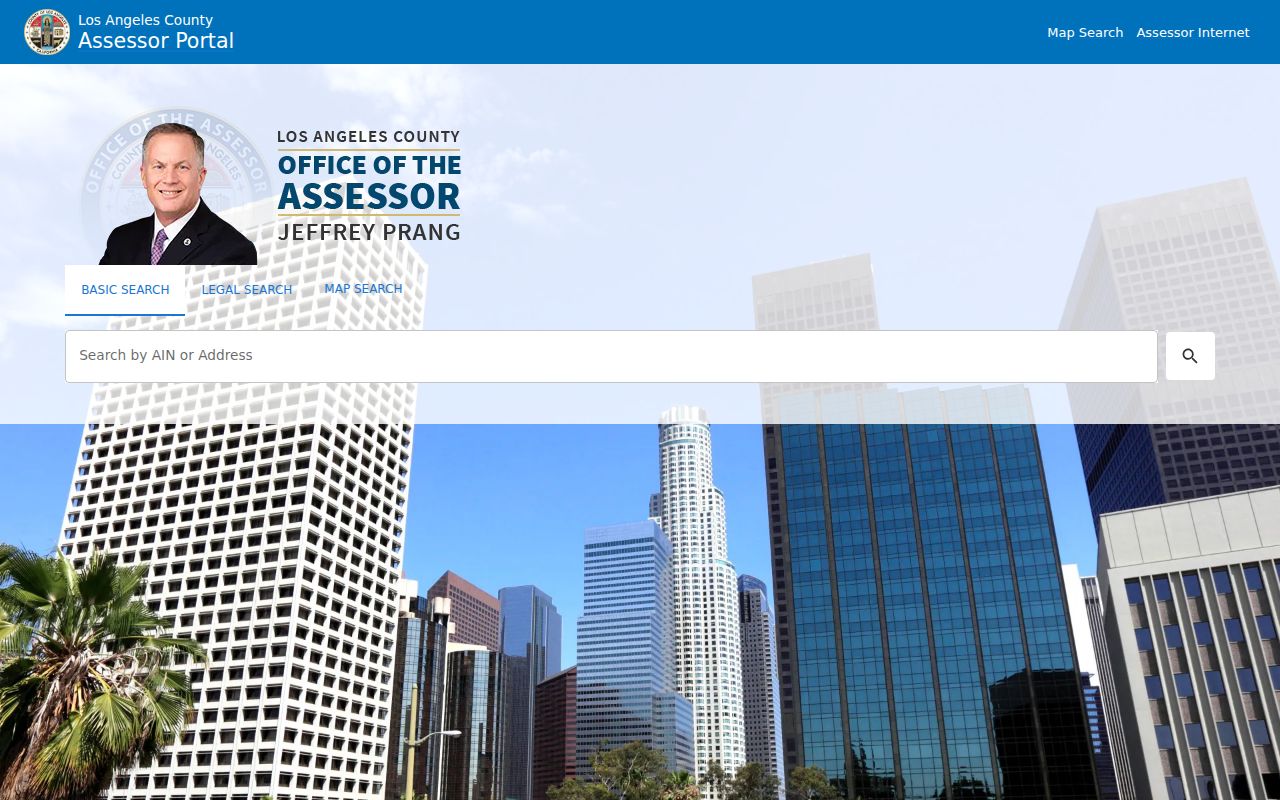
The assessor view shows why a Duarte residents directory search should keep owner, parcel, and occupant as three separate fields.
Note: Parcel geography helps locate a record, but it cannot turn a tax roll into a complete household list.
Why Duarte Deeds Stay Offline
Los Angeles County holds recorded real-estate material reaching back to 1850 or 1851. Yet the grantor and grantee index is not a public Internet search. County Counsel advised against online publication. The system cannot reliably flag protected officials whose home addresses deserve special treatment. So Duarte deed research happens at the Norwalk office. Index work there is arranged by grantor, grantee, and recording year. Material from 1851 through 1957 is reviewed on the lower level. Everything from 1958 onward lives on the second floor.
A grantor is the person or entity conveying an interest. A grantee receives it. Once an index entry supplies a document number or a book and page, that known document can be ordered. Ordering happens online, by mail, by fax, or at the counter. Telephone staff will not take exploratory index-search requests. Online copy orders are stated to take up to 20 working days. You must buy the complete instrument, not selected pages.
The RR/CC index-access instructions describe the appointment setup and floor arrangement. The county's real-estate request route handles known-document orders. A recorded deed can show vesting names, the legal description, execution and recording data, signatures, notarial acknowledgment, and return information, subject to redaction. Remember that a deed is a title record. It does not prove who sleeps at the address.
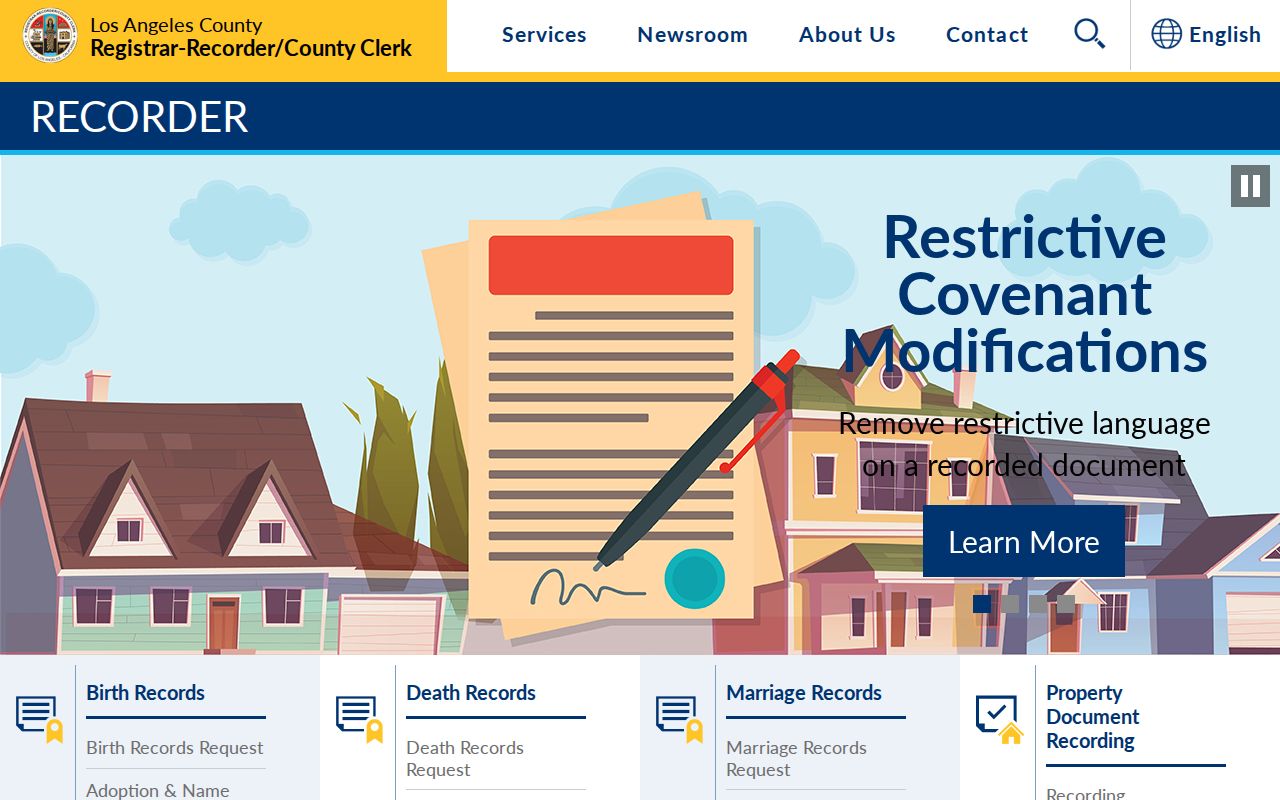
The recorder service view makes the address-to-name gap plain. Start with the Assessor Portal for the parcel, then bring names and years to Norwalk.
Current Duarte Resident Sources
Think of a current Duarte residents directory as a toolkit rather than a single database. Each source backs only a narrow fact. Some are free web lookups. Others demand a known record, a permitted purpose, or a request. Some may even require a visit to a library or records office. The table keeps every source tied to the fact it can actually support.
| Source | What It Can Show | Keeper | Access |
|---|---|---|---|
| Assessment parcel | AIN, situs, parcel context, mailing context | LA County Assessor | Free address/AIN portal |
| Recorded document | Grantor, grantee, legal description, recording details | RR/CC Recorder | Name/year index in Norwalk; known copy by request |
| Voter verification | Match to supplied last name, birthdate, house number, and ZIP | RR/CC Elections | Self-verification form |
| Superior Court case | Party role, case number, dates, public docket events | LA Superior Court | Case-number route; name/image services may charge |
| City permit file | Applicant, owner, contractor, work and inspection dates | Duarte City Clerk | Focused public-records request |
| Business or license filing | Entity affiliation, license status, filing address | California SOS or DCA | Free search; record-specific limits |
Match the tool to the question first. A parcel search can surface a property relationship. A court case can confirm a public role, and a license can verify a credential. None of them adds up to a full resident roster. For one person, the Duarte resident lookup workflow arranges the same facts in a safer order.
- Roll
- A government list or assessment record maintained for a stated purpose, not a complete census of residents.
- Index
- A finding aid that points to a fuller record, such as a deed or court file.
- Criss-cross directory
- A reverse directory arranged by street and number rather than surname.
- Parcel
- A mapped land unit used for assessment and legal description.
Duarte Voter Verification Limits
The Los Angeles County voter verification form exists so a voter can check a known registration. It asks for Last Name, Birthdate, House Number, and ZIP Code. Nothing else. Name-only search and street browsing are off the table. Nor is there a list of every registered voter in Duarte. A match only means the details line up. It never shows how anyone voted.
California voter data may include name, residence or mailing address, status, registration date, party preference, precinct, district, and election participation history. Not everything is public. Driver-license and identification numbers, Social Security numbers, other unique identifiers, and signatures are confidential, and home address, telephone, email, precinct number, and prior registration are protected from routine public access. Elections Code sections 2188 and 2194 allow limited election, scholarly, journalistic, political, or governmental uses, with restrictions against personal, private, commercial, harassment, solicitation, and unapproved Internet use.
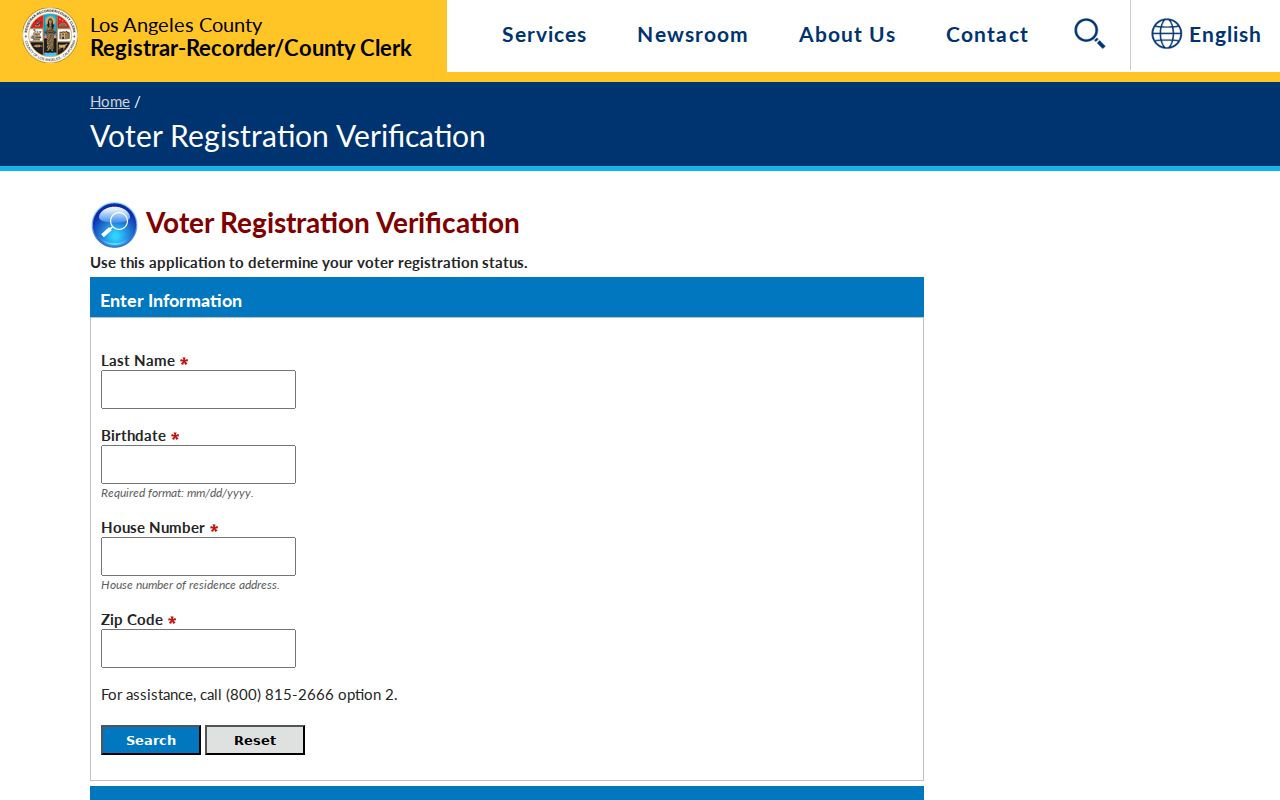
That four-field voter form is a verification checkpoint, not a public Duarte residents directory. It is not a roster. Election-file requests take a separate route in Norwalk. They require a purpose certification and a geography order.
Note: A failed voter match can reflect changed details or an input error, not proof that a person is absent from Duarte.
Duarte Court Records by Number or Name
Duarte matters go to the Superior Court of California, County of Los Angeles. Its Find a Case service has four parts. These are Case Access, Case Calendar, Case Document Images, and a name-based case-number search. Case access and calendar want a known number. Name and image services use separate fee-supported routes, and public categories do not all share the same image access.
A case summary may show case number, case type, filing courthouse and date, party names and roles, future hearings, register-of-actions events, and public dispositions. Civil and small-claims images can appear in the document service. Criminal and family-law images never do. Juvenile, adoption, sealed, confidential, and protected material remains closed. The online material is not the official court record.
The official LA Court Find a Case page is where searching starts, and the case-summary service states the scope and filing-courthouse fields. A name hit is only a lead. Confirm it against full name, middle initial, role, courthouse, filing date, and any public address in the actual filing. Probate cases can be gold for family history. A public petition may identify a decedent, petitioner, heirs, and estate property.
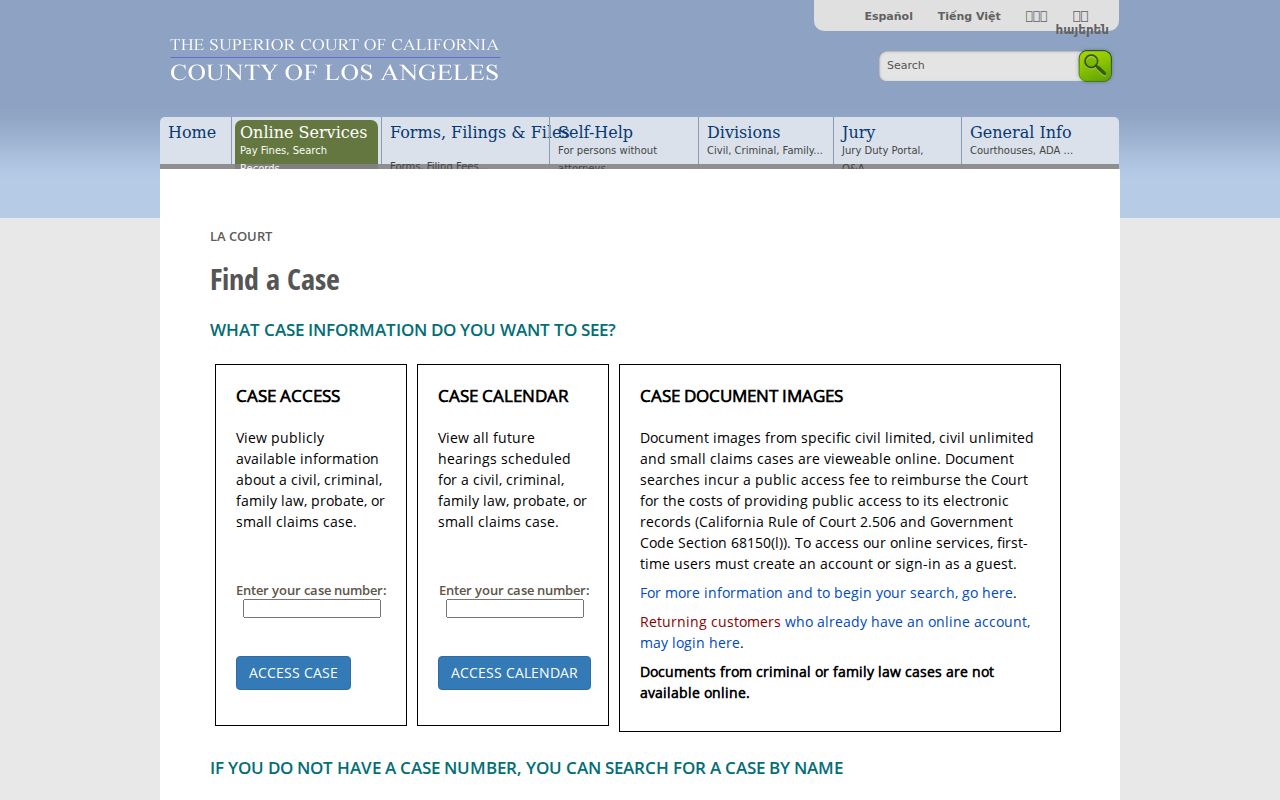
The case-search choices show why a name hit is only a lead. It takes a second record to settle identity.
Duarte Vital Records and Copies
Two custodians split the vital-record trail for Duarte. Los Angeles County RR/CC issues the county copies. The California Department of Public Health keeps the statewide birth, death, fetal-death or stillbirth, marriage, and divorce records. Nothing here opens on a simple year rule. California instead divides certified copies into authorized and informational versions.
The 2026 CDPH fee schedule lists $31 for a birth copy. A death copy runs $26. A public-marriage copy costs $19. A dissolution copy is $18. Confidential-marriage copies carry a $19 state fee where applicable. Only a spouse or a court order can obtain one. County and state issue different products, so confirm the custodian before mailing an application.
An informational copy shows the event details but carries the mark “Informational, Not a Valid Document to Establish Identity.” An authorized mailed request demands statutory eligibility plus a notarized sworn statement. CDPH uses VS 111 for births. It uses VS 112 for deaths. It uses VS 113A for public marriage. Applications go by mail to CDPH Vital Records in Sacramento. The search fee is retained when no record turns up. The official forms page carries the current application path. The fee page lists the 2026 amounts.
Family history rarely needs an identity-valid certificate. A newspaper item, cemetery entry, census line, probate file, or directory can set the lead instead. Adoption and original birth records stay sealed under their own process. Absence from a public index proves nothing about whether an event occurred.
Use Duarte's Records Request Fallback
Start with Laserfiche for posted Duarte legislative and administrative records. It is the first stop. Not every file lands there. A permit, agreement, or campaign filing may sit only at City Hall. Those need the city's Public Records Request Form. The form asks the usual basics. Expect fields for requester name, request date, address, city, state and ZIP, phone, email, and preferred contact method. Add a description with record type, date, title, subject, and time period. Direct duplication costs are explained on the form as well.
Ask for a file, not a people list. A focused address request works better. Supply the exact street address and the AIN if known. Add the approximate permit date, the project type, and the owner or applicant name. Then request the application, issued permit, plan-card chronology, inspection signoffs, or certificate of occupancy. Plan security and copyright limits can still apply. A 2025 cultural-resource study offers a real model. Consultants asked the City Clerk for subject-property permits. They dated the alterations from the returned files.
The California Public Records Act gives any member of the public the right to request an identifiable state or local record. It is Government Code section 7920.000 and following. Agencies ordinarily decide within ten calendar days whether responsive records exist. Unusual circumstances can add a written extension of up to 14 days. Prompt access under section 7922.530 is subject to direct duplication cost or a statutory fee. Remember what a request is. It reaches an existing record. It cannot command an agency to research a person or build a new roster.
Note: If the web trail ends, a narrow request is the next sound step. The custodian, library, archive, or records counter holding the missing series is the right target.
Duarte's Historical Directory Shelf
Older copies of the Duarte residents directory usually sit under Monrovia or Monrovia-Arcadia headings instead of Duarte alone. The Heritage Room at Monrovia Public Library holds an incomplete city and telephone directory run. It reaches from 1908 to 1971. Catalog and digital listings cover Monrovia-Arcadia-Duarte for 1924, 1925, and 1928. Duarte alone appears for 1937, 1939, 1944, and 1948. A single entry may list a resident, a spouse, an occupation, and a street address. The street section arranges adult occupants by house number. That helps when you want to trace who lived next door.
The Heritage Room keeps more than directories. Its shelf includes the 1957 Monrovia-Duarte Community Book. It also holds the 1938 History of Monrovia and Duarte, the 1943 Monrovia Blue Book, and the 1964 Historical Volume and Reference Work. Newspaper microfilm runs from 1886 through 1992 across named Monrovia and regional titles, with some gaps. Adult Services takes microfilm questions at (626) 256-8259. The room works by appointment at (626) 256-8274, and nearly everything stays in the building.
Closer to home, Duarte Library at 1301 Buena Vista Street offers research help. It also provides regional newspapers, county databases, and interlibrary borrowing. Doors open Tuesday and Wednesday from noon to 8 p.m. Thursday through Saturday they run from 10 a.m. to 6 p.m., with Sunday and Monday closed. The Duarte library resource page lists branch details, while the Monrovia Heritage Room page walks through its appointment-based local-history service.
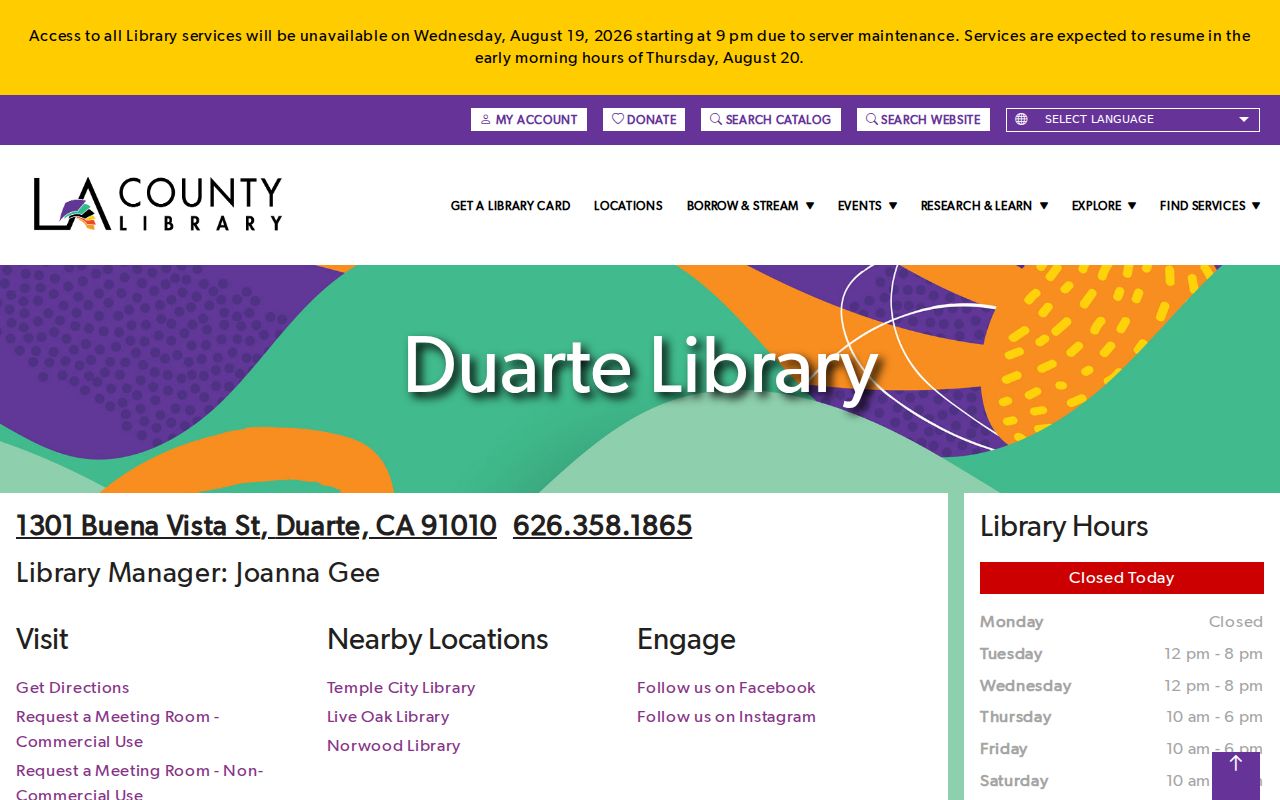
The library shelf is only half the story. Its help desk connects today's researcher to the combined-community volumes that preserve older Duarte households.
Land history opens other doors. The Duarte Historical Society and the Huntington Library's Bradbury Land Papers add photographs, local publications, and 54 items from 1855 through 1933 tied to Rancho Azusa de Duarte. Deeds, mortgages, leases, and water rights fill the set. The two collections offer different kinds of historical access.
Duarte Business and License Clues
Business and professional filings often serve two purposes. They can separate two people who share a name in a Duarte residents directory. They can also explain a name in a public record. The California Department of Consumer Affairs License Search covers the state's boards and bureaus. You can query by license type, license number, business name, first or last name, or registry number, plus an Advanced Search mode. A hit shows the license status, current or expired, along with any public discipline. Keep one caveat in mind. Some professions run on separate board systems. A blank result never rules out a license elsewhere in the state.
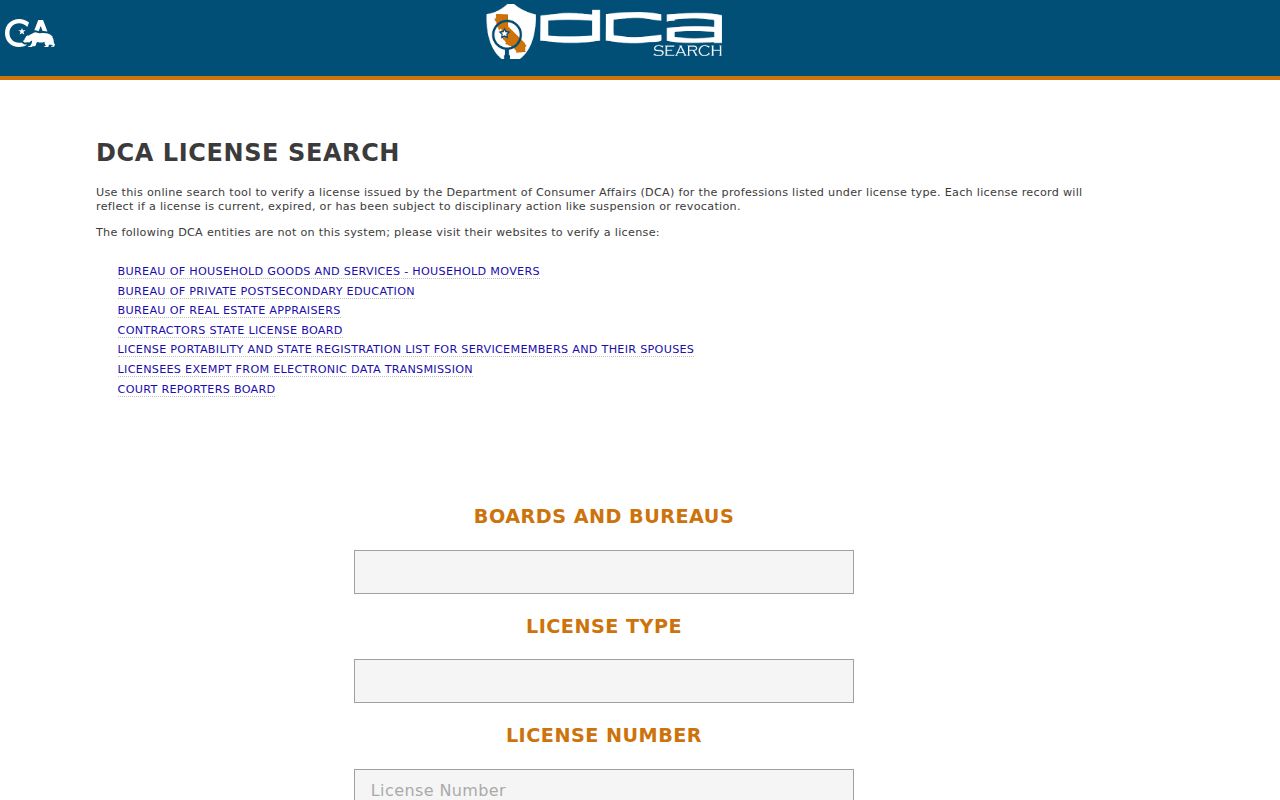
Treat the DCA result as a credential check only. It is not a residence record. Confirm the license number and board before tying a person to Duarte. For entities, the California Secretary of State bizfile indexes corporations, LLCs, limited partnerships, and nonprofits by name or number. A keyword search returns as many as 500 close matches. Advanced Search narrows entity type, status, and initial filing date. A Statement of Information can list the entity number, jurisdiction, principal and mailing addresses, agent for service, officers or managers, and the filing date. Remember one boundary. A business address on file is not a home address.
The entity result view works well for identity and filing history, particularly around City of Hope's institutional and health setting, but it stays separate from any proof of residency.
Duarte Unclaimed Property Leads
California's official ClaimIt search takes a last or business name or a property ID, with optional first name, city, and ZIP. Exact matches list first. A hit can surface an old Duarte connection or a reported owner address, but it proves nothing about where someone lives now. Go through the state service directly. The search itself is free.
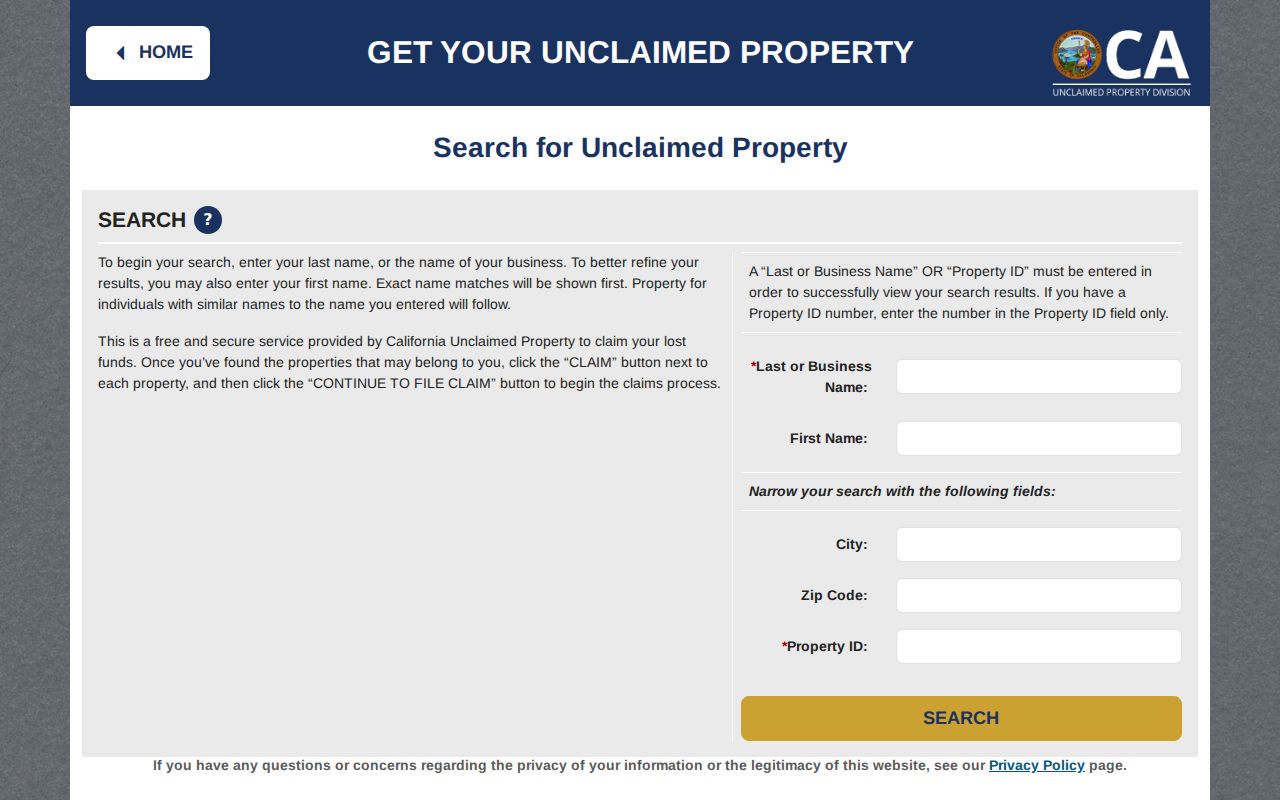
The optional city and ZIP fields give ClaimIt real value as a side path when a name is solid but the address trail has gone cold. Any family or property lead still needs confirming with the actual custodian of the record.
Duarte Privacy Limits on a Lookup
California's Safe at Home program provides qualifying participants a substitute mailing address and mail forwarding. It also provides an agent for service of process. State, county, and city agencies generally accept that address, subject to statutory exceptions. The courts do as well. Voter rolls and DMV data are not open directories. The federal Driver's Privacy Protection Act further restricts DMV personal information. A recorded deed cannot be wiped out just because an address is inconvenient. Corrections and redactions must go through the custodian. They must also follow the specific legal process that governs the record.
Lawful personal use. Duarte records are useful for family history, property curiosity, civic research, and reconnecting with people who want contact. Do not use a lookup to stalk, harass, threaten, or harm anyone. California Penal Code section 646.9 and voter-data restrictions can carry serious consequences.
Commercial people-finder products go stale, merge different names, and blend public and private feeds. None of them replaces an assessor record. None replaces a court file, a certified vital copy, or a library source. On removal, California privacy rights may support deletion, correction, or opt-out requests for covered data held by a broker. That still does not erase an underlying deed or court record.
| Official record path | Commercial people-finder category |
|---|---|
| Named custodian, stated record role, and access rule | Mixed feeds that may merge names or lag behind corrections |
| Parcel, case, deed, vital, or directory source can be checked directly | Result may point to a source without proving the underlying fact |
| Correction, copy, sealing, or redaction belongs with the custodian | Removal request affects the listing, not the official record |
Note: The custodian, not a search result, decides whether any record is accurate, public, sealed, corrected, or protected.